
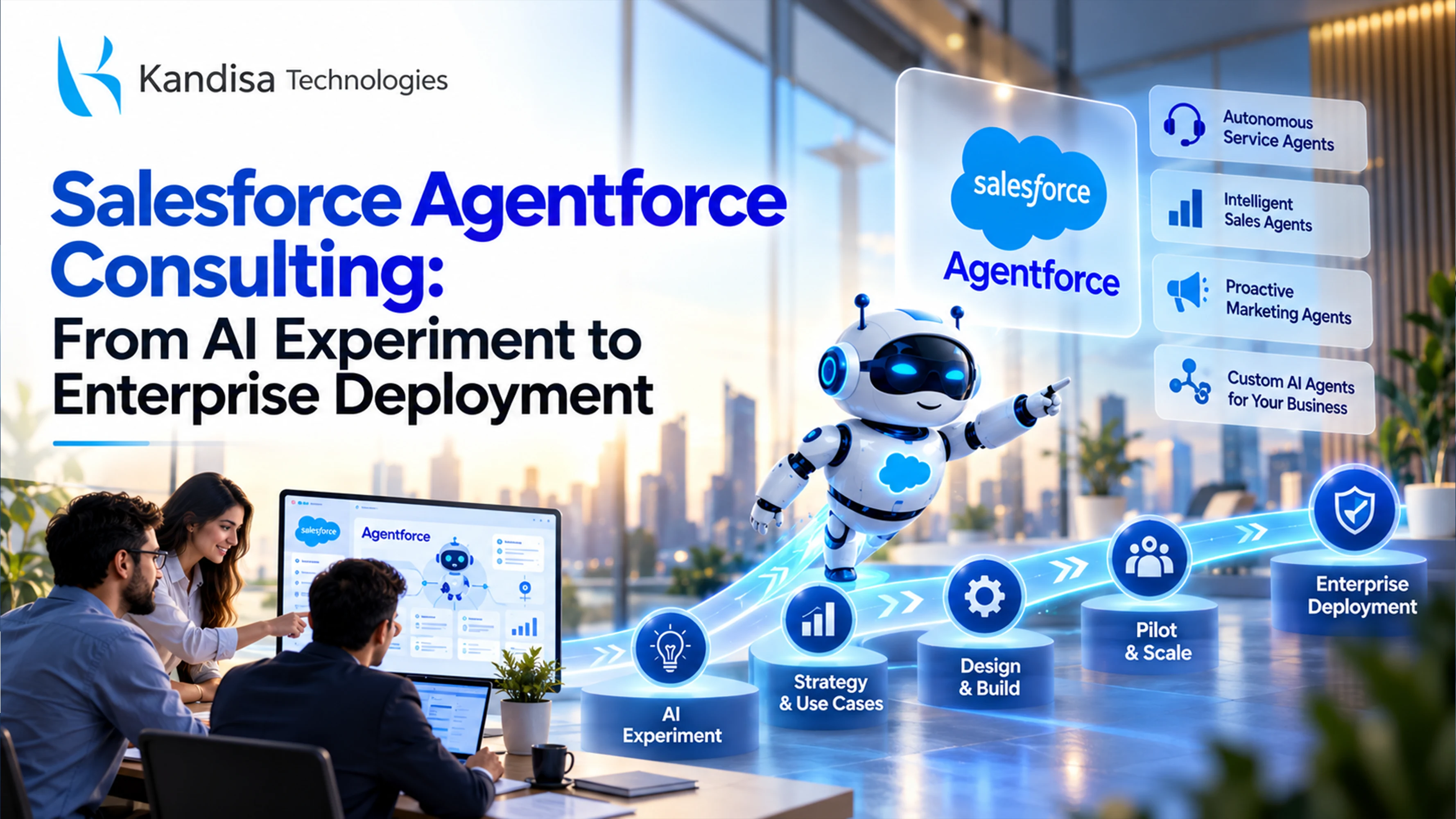
Businesses are experimenting with AI faster than ever, but getting an AI-powered demonstration to work is only the beginning. The real challenge starts when that technology needs to handle customer enquiries, access business information, follow established processes and deliver consistent results across departments.
Salesforce Agentforce offers organisations a way to build AI agents that operate within their existing Salesforce environment. These agents can support customer service, sales operations and internal workflows by retrieving relevant information and performing authorised actions.
Yet enterprise deployment requires more than configuring an agent. It demands reliable data, secure integrations, clear operating boundaries and ongoing performance management.
This is where an experienced Salesforce Implementation partner becomes valuable, helping businesses turn isolated AI experiments into dependable solutions that support everyday operations.
What Is Salesforce Agentforce Consulting?
Salesforce Agentforce consulting is the process of planning, designing, implementing and optimising AI agents using Salesforce’s Agentforce platform.
Unlike conventional chatbots that primarily respond to predefined questions, Agentforce agents can use business context, select appropriate actions and interact with connected Salesforce workflows.
A Salesforce Consulting partner helps organisations determine which tasks are suitable for AI, how agents should interact with enterprise systems and what controls are needed before deployment.
The objective is not simply to introduce AI into existing operations. It is to identify where intelligent automation can produce measurable improvements without compromising accuracy, security or customer experience.
Why AI Experiments Often Struggle to Reach Production
A successful proof of concept demonstrates that an AI agent can perform a particular task under controlled conditions.
Enterprise environments are rarely that predictable.
Customer information may be stored across several platforms. Business processes can involve multiple approval stages, and a single incorrect response might affect customer relationships or internal decisions.
Common deployment challenges include:
- Disconnected business data: AI agents cannot provide reliable answers when essential information is incomplete, outdated or inaccessible.
- Unclear responsibilities: Without defined permissions, agents may attempt tasks that require human approval.
- Insufficient testing: Successful demonstration scenarios do not account for unusual requests, conflicting information or system failures.
- Integration difficulties: AI capabilities must work alongside existing CRM configurations, APIs and business applications.
- Limited performance visibility: Organisations need evidence that deployed agents are improving operational outcomes.
Addressing these issues early helps prevent expensive redesigns after implementation.
From AI Experiment to Enterprise Deployment: A Practical Roadmap
A structured implementation approach allows businesses to evaluate Agentforce against operational requirements before expanding its responsibilities.
1. Identify Business Processes Worth Automating
Not every workflow needs an AI agent.
The first step is identifying activities where repetitive work, delays or inconsistent information create measurable problems.
Potential Agentforce use cases include customer enquiry handling, lead qualification, case information retrieval, appointment coordination and internal knowledge assistance.
Each proposed use case should have a defined business objective.
For a customer service agent, that might involve reducing routine case-handling time while maintaining response accuracy and a clear route to human support.
A Salesforce Implementation partner can assess technical feasibility alongside business impact, ensuring the initial deployment has a practical purpose.
2. Prepare Enterprise Data for AI
AI agents depend on the quality and accessibility of the information they use.
Salesforce Data 360 can help connect customer and enterprise information, including structured records and relevant unstructured content.
Retrieval-augmented generation, or RAG, allows agents to retrieve approved information when generating responses rather than relying exclusively on a language model’s existing knowledge.
Before implementation, organisations should review:
- CRM data accuracy and ownership
- Access permissions and sensitive information
- Connections with external business systems
- Knowledge articles and document quality
- Data retrieval and updating requirements
Data preparation is not simply a technical exercise. It directly influences whether employees and customers can trust an agent’s responses.
3. Design Agents Around Real Business Workflows
Once the data foundation is established, the next step is defining what an agent can do.
Salesforce Agentforce Builder supports agent configuration, while subagents and actions help organise tasks and connect them to business operations.
Existing Salesforce Flow, Apex and supported integrations can form part of these workflows.
An agent assisting with customer service might retrieve an order status, explain a return policy or initiate an approved process.
Its responsibilities should also have clear limits.
Requests involving exceptions, sensitive decisions or unavailable information may need to be transferred to a human employee.
Designing these boundaries early creates more predictable agent behaviour and simplifies testing.
4. Establish Security and AI Governance
Enterprise AI introduces questions that extend beyond technical functionality.
Who can access customer records? Which actions require approval? What happens when an agent receives misleading instructions?
Salesforce provides security capabilities through existing access controls and the Einstein Trust Layer, which incorporates safeguards for generative AI interactions.
Organisations must still configure these capabilities according to their own governance requirements.
A strong deployment plan should address permission management, data protection, audit requirements, human oversight and incident escalation.
Working with a Salesforce Consulting partner can help align these safeguards with established business policies.
5. Test Agent Behaviour Before Deployment
AI agents do not always respond identically to every variation of a request. Testing must account for this variability.
Salesforce Agentforce Testing Center supports scenario-based evaluation, including response quality, action selection and knowledge retrieval.
Testing should cover routine enquiries alongside incomplete information, unexpected requests, conflicting instructions and situations requiring escalation.
Sandbox testing is especially valuable because it allows teams to examine agent behaviour without exposing live business operations to unnecessary risk.
Technical success is only one measure. Business users should also confirm that responses are useful, understandable and consistent with operational expectations.
6. Deploy Gradually and Monitor Results
Enterprise deployment does not have to begin with company-wide access.
A controlled rollout involving one team, process or customer segment allows organisations to collect feedback and identify performance issues.
Salesforce Agentforce Observability provides tools for reviewing agent interactions and performance, including analytics and optimisation capabilities.
Businesses can monitor metrics such as:
- Successful task completion
- Human escalation rates
- Response accuracy and resolution quality
- Employee time spent on repetitive tasks
- Customer satisfaction
- Usage and operating costs
These measurements help determine whether an agent should be improved, expanded or assigned a narrower role.
Continuous optimisation is essential because enterprise information, customer expectations and business processes change over time.
Why Work With a Salesforce Implementation Partner?
Deploying Agentforce involves CRM architecture, integration design, AI configuration, security and change management.
A qualified Salesforce Implementation partner brings these areas together within a coordinated delivery plan.
Rather than treating Agentforce as a standalone tool, the partner can assess how it fits into an organisation’s existing Salesforce investment.
This includes evaluating current automations, identifying reusable components, resolving data dependencies and designing a practical implementation roadmap.
A Salesforce Consulting partner can also support employee training, deployment documentation and post-launch improvements.
The value lies in building an AI capability that businesses can operate and maintain, not merely demonstrating that the technology works.
Choosing an Indian Salesforce Partner for Agentforce Implementation
For organisations evaluating international delivery options, an Indian Salesforce partner may offer access to Salesforce development, integration and consulting expertise.
The selection process should focus on demonstrated technical capability rather than location or pricing alone.
Businesses should assess the partner’s experience with Salesforce architecture, Agentforce capabilities, data integration, security and enterprise deployment.
It is equally useful to understand how the consulting team handles testing, change requests, documentation and support after launch.
Ask prospective partners to explain their approach to agent governance, integration complexity and measurable business outcomes.
A clear delivery methodology is often a stronger indicator of suitability than an ambitious promise about automation.
Building an Enterprise AI Strategy That Lasts
AI adoption becomes valuable when the technology fits naturally into the way a business operates.
Salesforce Agentforce provides tools for creating intelligent agents, but sustainable deployment depends on thoughtful implementation decisions.
Businesses need to begin with a realistic use case, establish trustworthy data access, introduce appropriate safeguards and evaluate performance against clearly defined objectives.
A capable Salesforce Implementation partner helps connect these decisions, supporting a transition from early experimentation to reliable enterprise operations.
For organisations planning their next stage of Salesforce AI adoption, Kandisa Tech can be a starting point for discussing implementation requirements, integration priorities and an Agentforce deployment roadmap.